Public Sector
Public Sector
Less time spent on case files. More time for substantive review.
Legal Cognition analyses case files and prepares draft correspondence with source references for review. The AI draws on the collections of decisions and documented experience you provide. You define the professional guidance and review steps it must follow. You run this state-of-the-art infrastructure, including the AI models, on your own systems. Retain full sovereignty. Your case files are processed within your organisation.
Work at a glance
See which assignments your agents have completed and which results are awaiting professional review.
Activity log
Track when case files were created, results were released for review and matters were closed.
Explore security controlsOn your infrastructure
Legal Cognition and the AI models run on your own systems. Case files, knowledge sources and work products remain within your organisation.
Explore deployment options


For courts and public authorities, handling a case often starts with bringing together information from many documents. Later submissions add to earlier arguments, technical reports refer to different design revisions, and information material to a decision may be found in annexes or correspondence. Establishing how these documents relate takes time and a detailed knowledge of the file.
Legal Cognition helps with this work by analysing documents, setting conflicting statements side by side with source references, and preparing drafts for further work. Referenced passages can be opened directly in the original document. Judges and the people responsible for the case within a public authority can check the findings and follow up on unresolved questions.
A key benefit is the ability to draw on knowledge from your own practice when handling further cases. Collections of past decisions, professional guidance and documented lessons from previous work can be made available to agents as knowledge sources. Instructions specify how a task should be carried out, which checks are required and when to ask for clarification or approval. Responses and drafts can then take account of the experience and professional guidance provided by your organisation.
You determine which files and sources the AI may draw on and which tools it may use. Legal Cognition, including the AI models, can run entirely on your own infrastructure. In this local deployment, your files and their processing remain within your organisation. You retain full control over the models, access rights and permitted connections. This gives you state-of-the-art infrastructure for legal work that draws on your own knowledge and procedures while preserving your data sovereignty.
Compare submissions and evidence
Identify the facts each party puts forward and the documents they rely on. Legal Cognition brings these statements together with source references and flags discrepancies and open questions for further review.
A party’s allegation, a submitted document and a professional assessment remain distinct. Open the relevant passage directly from the overview.

Diagram the parties’ submissions on acceptance and link the supporting evidence to its source passages.
Payment claim · disputed acceptance
The parties give different accounts of the conclusion of the test run on 12 May. The claimant alleges acceptance without reservation; the defendant denies declaring acceptance and points to malfunctions. The diagram below links each account to the evidence offered or submitted in support of it.
Was acceptance declared?
DisputedClaimant
Submits that the defendant accepted the installation without reservation.
Evidence offered
Witness Anna Weber
Named to testify about the alleged declaration of acceptance after the test run.
Defendant
Denies acceptance and alleges faults during the test run.
Document submitted
Email of 13 May
Refers to use of the installation and unresolved faults.
Assessment of the evidence
Anna Weber is named as a witness to the alleged declaration of acceptance. She has not yet been heard in this fictional case, so the offer of evidence does not yet provide testimony that could be assessed.
The email of 13 May refers to use of the installation and unresolved faults. It does not expressly state whether acceptance was declared the previous day. Further evidence is needed to resolve this disputed point.
Cited documents

Review permit documents in context
Applications, technical reports and authority responses do not always refer to the same design revision. Legal Cognition compares the documents and links discrepancies to the relevant source passages.
In this recycling facility expansion example, operating hours, traffic assumptions and storage areas are not consistently reflected. The review memorandum informs a draft information request; technical assessment and the decision remain with the responsible authority.
Check whether the expansion documents reflect the same design revision. Identify discrepancies and outstanding information requests with source references.
Documents in the sample file
The eight documents contain four discrepancies concerning operating hours, traffic, storage areas and design revisions. The work plan is ready. Before drafting the information request, I have two questions about its format.
Review the amendment application
Compare design revisions and technical assumptions. Document discrepancies and prepare an information request for review by the authority.
Documents
Work steps
- Read eight documents and identify their revisions.
- Compare operating hours, traffic and storage areas.
- Support four review points with both sources.
- Prepare a draft information request.
Draft instructions
Please choose the structure and internal note in the chat. The draft will only be created after your approval.
Configure agents for your procedures
Define the instructions, knowledge sources and capabilities an agent uses for its task. Evaluate its work against selected examples and your professional criteria.
Connections to existing case and document management systems are scoped separately around the interfaces required.
Systems and interfaces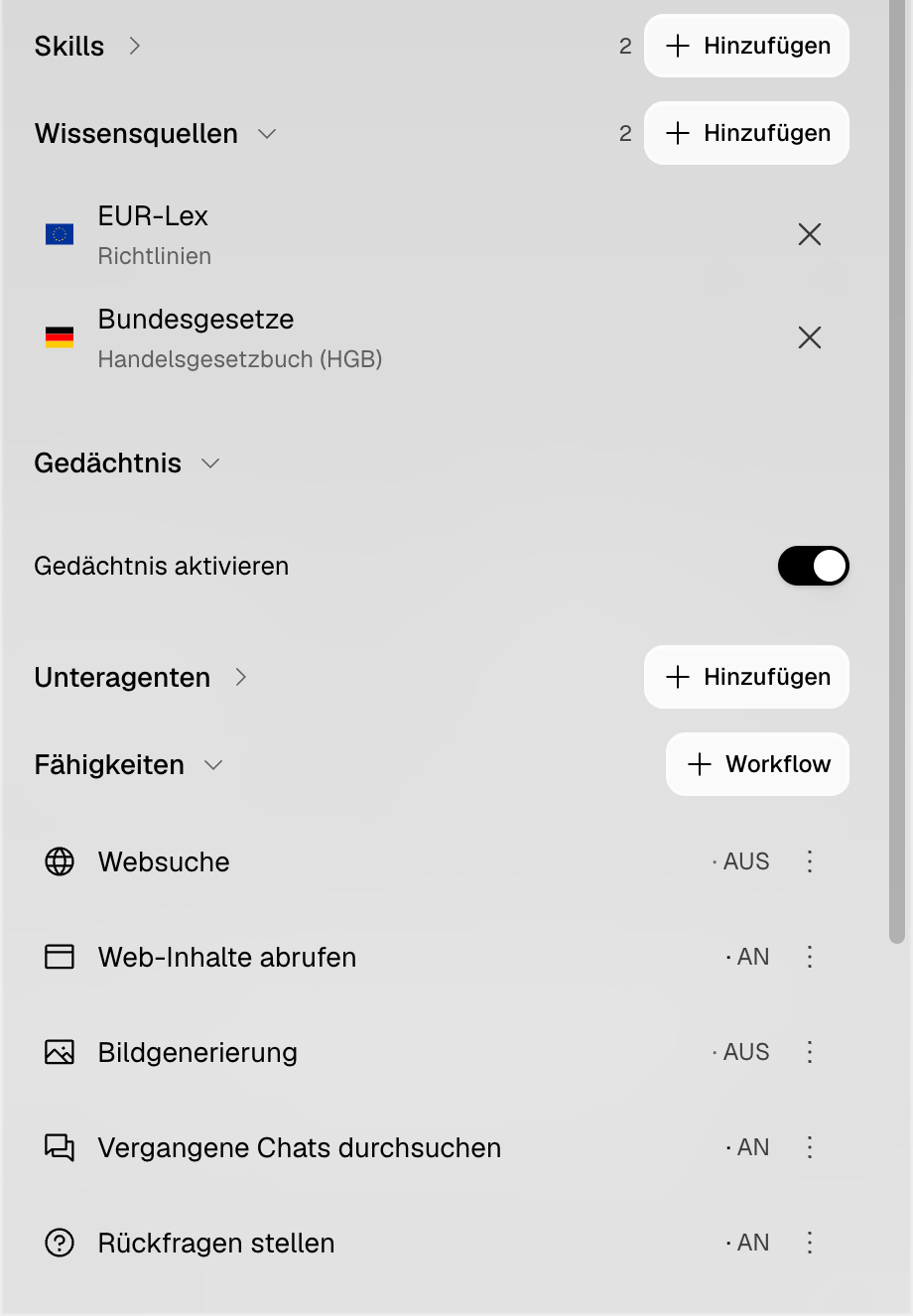
Set up monitoring
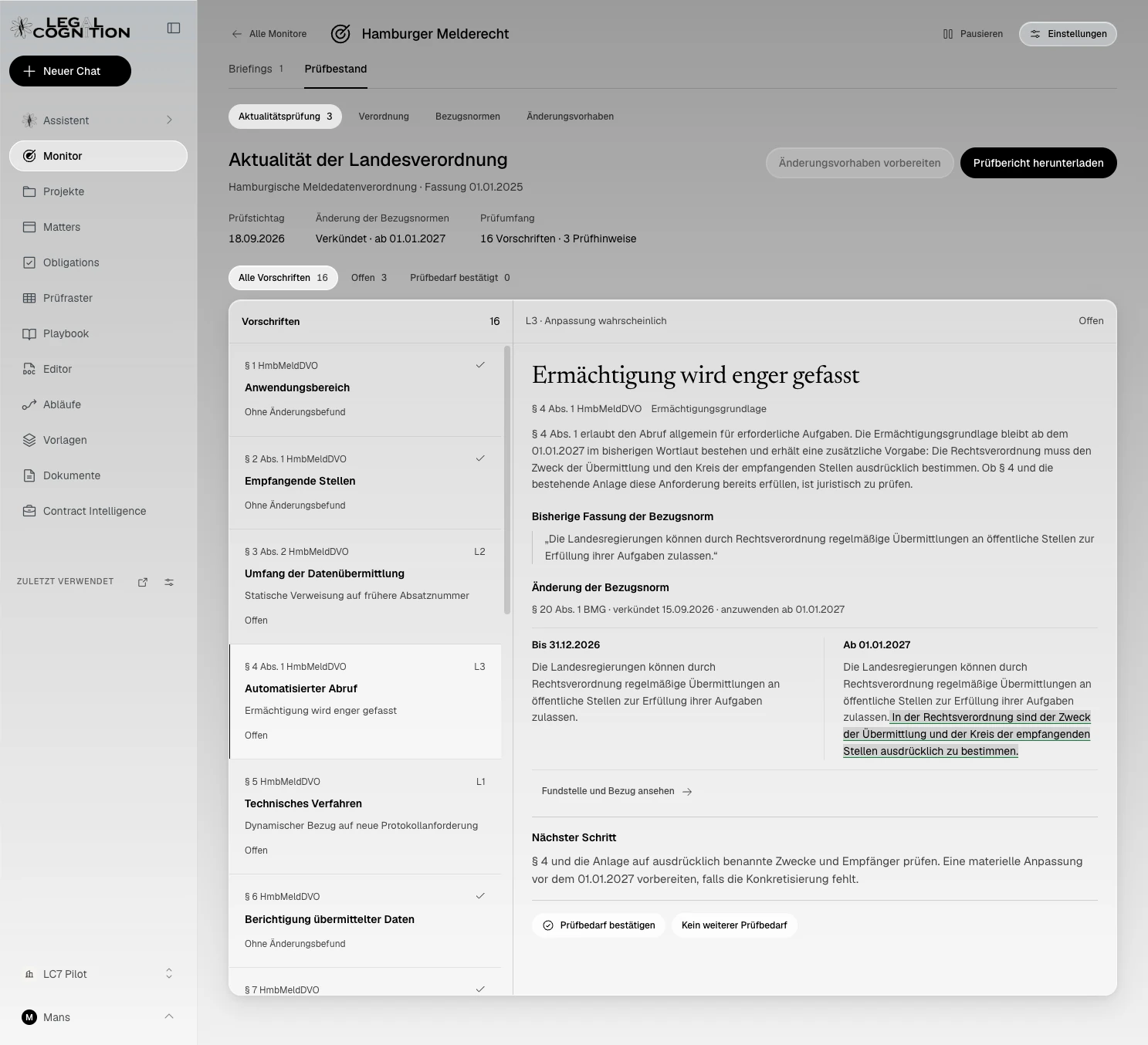
Choose the areas of law, jurisdictions and available sources you want to monitor. Monitors records new legislation, court decisions and publications from public authorities with source references and publication status.
Assess which of your regulations or templates may be affected and assign further review to the responsible people. Where a need for amendment is confirmed, prepare draft changes with a side-by-side comparison and reasoning. You decide what is approved.

Questions about implementation
Working with Legal Cognition
What tasks does Legal Cognition support?
Legal Cognition supports casework from the initial review to a draft ready for professional review and approval. It produces factual summaries, timelines and overviews of the parties with source references, and answers questions about the case file.
Similar documents can be assessed together in a table. Applications, contracts and drafts are checked against your checklists, administrative rules and internal instructions, with departures identified.
Administrative decisions, orders and opinions are drafted using your templates and can be edited further in Word. Legal Cognition also tracks deadlines and appointments and manages contract portfolios, including contract terms and notice periods. Recurring steps can be saved for use in subsequent cases.
Which sources does Legal Cognition use?
It starts with your own materials: case files, administrative rules, standard correspondence and your organisation’s documented experience. These are complemented by a dedicated collection of German federal and state legislation and case law from federal and state courts. The entire collection can be held on your premises. Searches within it do not send queries to external search services.
How do we review the results?
Results and drafts identify the passages in the case file, legislation and court decisions on which they rely. You can open the references and check each statement against its source. Any necessary changes can be made directly in the draft.
Does Legal Cognition make decisions?
No. Legal Cognition analyses documents, conducts research and produces suggestions and drafts. The responsible person reviews the work and carries out the assessment, decision and sign-off themselves.
Deployment and information security
Can we run Legal Cognition without external connections?
Yes. The entire application, including the language models and the collection of legislation and case law, can run in your data centre or with your IT service provider, such as a state government data centre. In this deployment, neither documents nor queries leave your network.
Can we also use external language models?
Yes. Your organisation decides whether to connect external models and which ones to use. Before transmission, Legal Cognition replaces detected personal information with placeholders according to the configured protection rules and checks outgoing content for remaining personal information. Detection and the mapping to the original information take place locally. Replaced information is restored in the response only within your own environment.
How do we receive updates?
Updates to the software and the legal collection are delivered through a secure connection. If your deployment has no external connection, our engineers install the updates on site.
How does Legal Cognition fit into IT-Grundschutz?
We provide a mapping to the relevant modules of the BSI IT-Grundschutz Compendium, identifying the requirements the application meets. Your information security officer can use this when developing and maintaining your security concept.
Data protection and legal requirements
Is our data used for training?
No. Case files, queries and results are not used to train language models. External model providers connected to the system are contractually prohibited from using your data for training.
Who can access each case file, and can access be traced?
Your administration assigns roles and permissions and determines who may view and edit each case file. When logging is enabled, access to case files and changes are recorded; existing log entries cannot be altered.
Logging can be disabled on request. Subsequent activity will then no longer be traceable through this log. Any documentation obligations applicable to the intended use must be established beforehand.
How is Legal Cognition classified under the EU AI Act?
Classification depends on the specific intended purpose and tasks. Systems that assist courts in examining facts and law may also fall within the high-risk rules. A final decision made by a person does not, on its own, rule out that classification.
Whether an exemption applies to a particular use requires a separate assessment. Legal Cognition is not intended for automated decision-making.
Procurement and getting started
How do we procure Legal Cognition?
The procurement route depends on the contract value and the rules applicable to your organisation. We provide contract templates aligned with the German EVB-IT terms, a data processing agreement under Article 28 GDPR and a description of the system’s capabilities for your procurement documents.
Should the staff or judicial council be involved?
This should be assessed early under the rules applicable to your organisation and the intended use. Particular consideration should be given to working procedures and logging functions. Disabling logging does not, on its own, settle the question of participation rights.
We are happy to present Legal Cognition to your staff or judicial council and explain its functions and configuration options.
How do we get started?
We begin with a demonstration based on a task from your organisation. This can be followed by a pilot in a court chamber, judicial panel or specialist department.
Together, we define the expected results and how they will be reviewed. We also establish the documents and sources needed, the deployment model and permissions. Documentation for data protection, information security and procurement is provided at the outset.
Can Legal Cognition be used in a regulatory sandbox under Germany’s Bundeserprobungsgesetz?
Legal Cognition can be used to test new working procedures, from case-file analysis and research to a draft for professional approval. Whether a project meets the requirements for a regulatory sandbox under the Bundeserprobungsgesetz, and which approvals it requires, must be assessed for that project.
We help you describe the project and prepare the application. Together, we define the steps, duration and evaluation criteria, such as processing time, manual rework and the professional quality of drafts. The documentation required for the trial is agreed in advance.
FOR COURTS AND PUBLIC ADMINISTRATION
Sovereign AIfor justice and public administration.
Discuss a specific use case and your organization’s requirements with us – from existing case management systems and professional review and approval processes to deployment on your own infrastructure.