For law firms and legal departments
Handle client matters, legal questions and contract portfolios according to your organisation’s professional standards. Sources, changes and approvals remain documented.


AI infrastructure for professional legal work.
Book a demoDomain-specific AI agents carry out multi-step assignments, apply your organisation’s standards, and submit their results—including sources and proposed changes—for review and approval.

Prepare a statement of defence using the supply agreement, the statement of claim and our correspondence.
Review the outstanding purchase price claim against the available documents and draft a statement of defence.
Whether and on what terms acceptance took place remains to be clarified.
The finished draft remains a working document for professional review.

Can you show me the company’s ownership structure?
The ownership structure here includes both the shareholders of Nordstern Technologie GmbH and its holdings in other companies. A shareholder list alone would therefore answer only part of the question.
Direct and indirect equity interests are relevant to this overview. Voting rights and special rights are distinct from these; an ownership percentage alone does not establish them.
The specific companies and percentages need support from register extracts and shareholder lists. Next, I need to check the commercial register.
Simulated register access using fictional sample data.
Yes. Here is the ownership structure of Nordstern Technologie GmbH from our fictional example.
Shareholders of Nordstern Technologie GmbH
The shareholdings add up to 100%.
Company investments
Direct and indirect ownership
Max Mustermann directly holds 55% of the parent company. His calculated indirect interest in Nordstern Services GmbH is therefore 41.25% (55% × 75%).
This overview shows equity interests. Different voting rights or special rights are not yet reflected here.
Would you like a visual representation of the ownership structure?
Create agents with your own instructions, legal knowledge sources and capabilities such as research or document review. Put them to work on your assignments and evaluate their work against criteria you define.
Use it in your working environmentFollow a citation to open the original document with the relevant passage highlighted. Read the source text to check whether it supports the statement in the answer.
More about verifiabilityMay the board assign risk control and internal audit to our CCO under decision paper BV-2026-17 if an external review takes place annually?
Summarise the obligations of Dr. Michael Weber towards Anna Keller under the draft settlement in case 4 O 217/25.
Legal Cognition replaces detected personal information in questions and documents with placeholders before sending the content to an external AI model. Authorised users see the original information restored in the answer.
More about PII maskingAssign a lease review to a tenancy law agent or ask a corporate law agent to review company resolutions. The agent works from the documents you provide and the professional guidelines you have specified.
Legal Cognition is developed in Germany by lawyers and AI developers. Its starting point is continental European legal methodology, with its systematic approach to legislation, doctrinal relationships and application of legal rules to the facts of each case.
01
Which provision applies? What are its conditions and legal consequences? How does it relate to other provisions? These relationships determine how we structure legal analysis in the product.
02
Our lawyers define how the relevant facts are assessed against the legal requirements. This includes interpreting provisions and considering case law and legal scholarship. The reasoning should make differing views and unresolved requirements clear.
03
Lawyers and AI developers work together to implement these requirements in research, document review and the work of AI agents. They determine which review steps are needed, which sources are consulted and how an assessment can be checked by a legal professional.
01 / AI agents

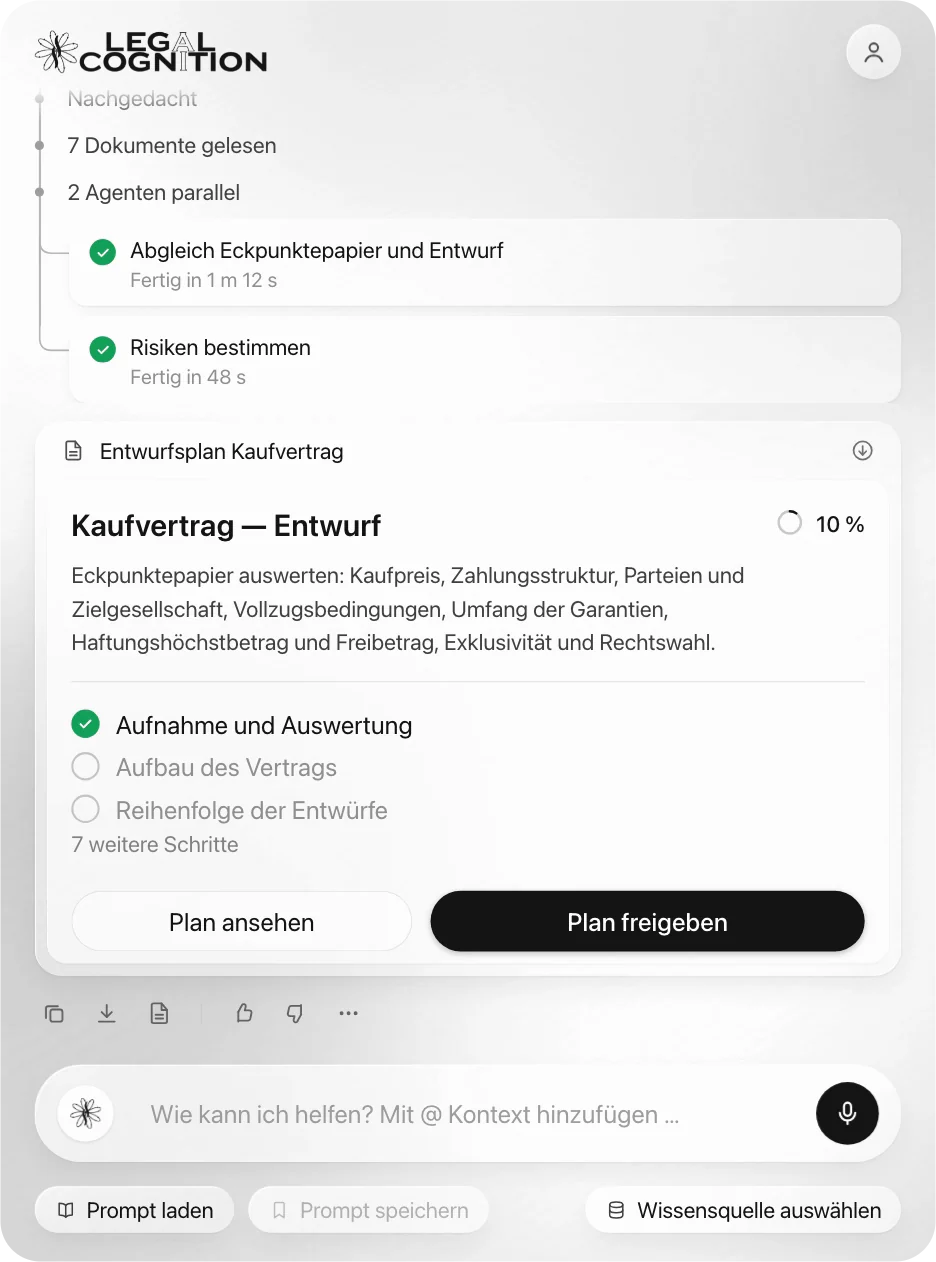
Assign AI agents to conduct research, review extensive documentation or prepare drafts. They break the assignment into steps, use the necessary tools and apply your organisation’s knowledge.
Legal assessments and factual findings are supported by legal authorities and document references. You can consult the cited passages in the original sources.
You decide which steps require your approval. At those points, the agent pauses and submits its work for your review.
Selected emails, documents and matters are monitored for issues requiring attention. Reviews start at scheduled times or when relevant changes occur.
02 / Matter

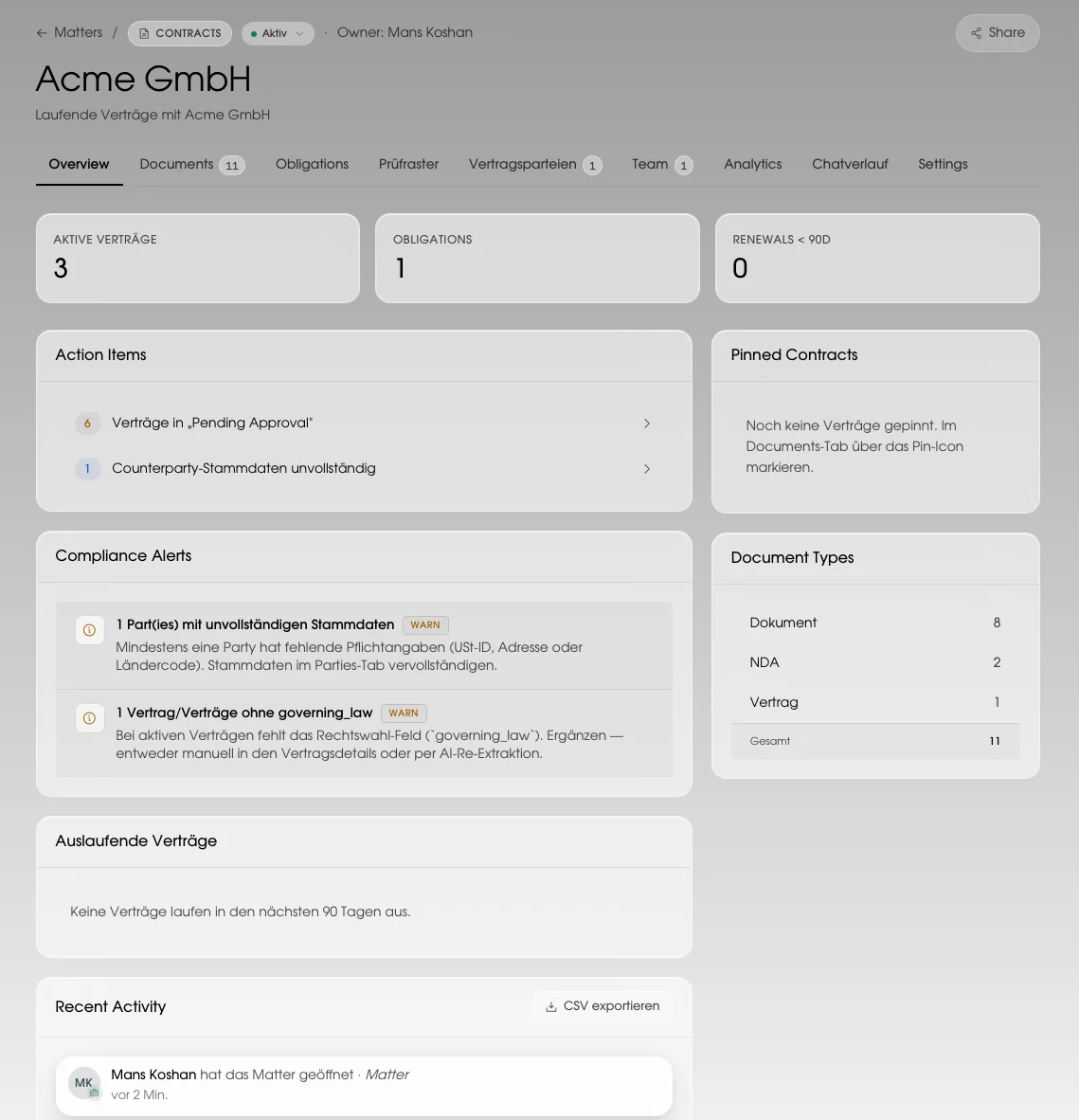
A matter brings together the documents, participants and tasks for an engagement or proceeding. You can check its progress and open the related documents and review findings.
An acquisition calls for different information and review steps from court proceedings. The fields, views and processes reflect the type of matter you are handling.
You determine which documents and functions internal and external participants can use. Permissions reflect each participant’s role in the matter.
Pending reviews, identified risks and decisions requiring attention are brought together in the matter. You can work through them using the related documents.
Changes, document access and approvals are logged in the matter. You can see who carried out each action.
03 / Obligations

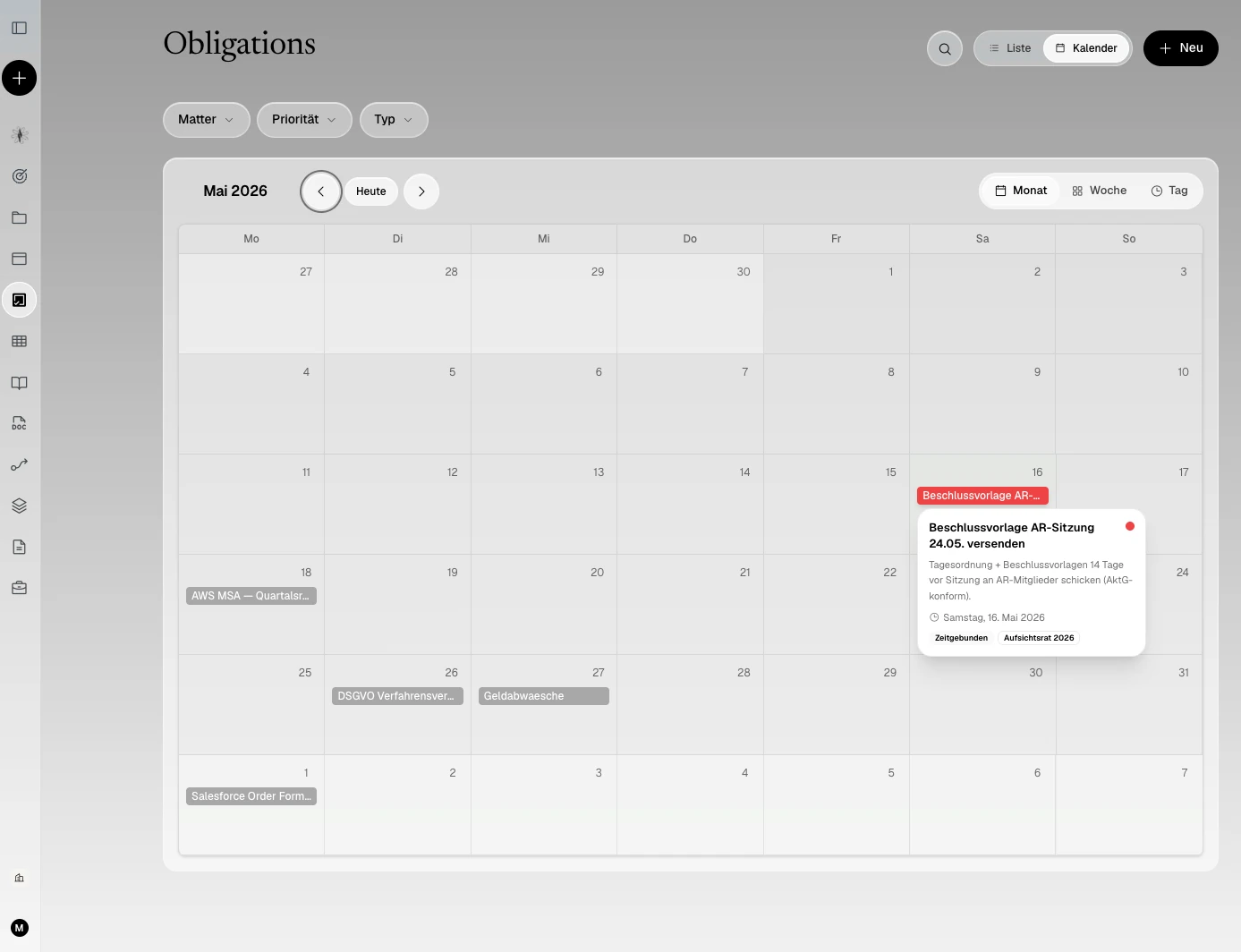
Obligations brings upcoming deadlines and duties from your matters into one overview. You can see when action is needed, who is responsible and what remains outstanding.
Legal Cognition identifies notice deadlines, contract renewals and other obligations in your documents. You can check the extracted information against the relevant passage.
Choose how much time you need to prepare. Reminders prompt you to take the required action ahead of the relevant deadline.
Assign the work to a responsible person. For each obligation, record its status and the next required step.
The deadline calendar shows upcoming dates across your matters. Filter the view by matter, priority and entry type.
04 / Tabular Review

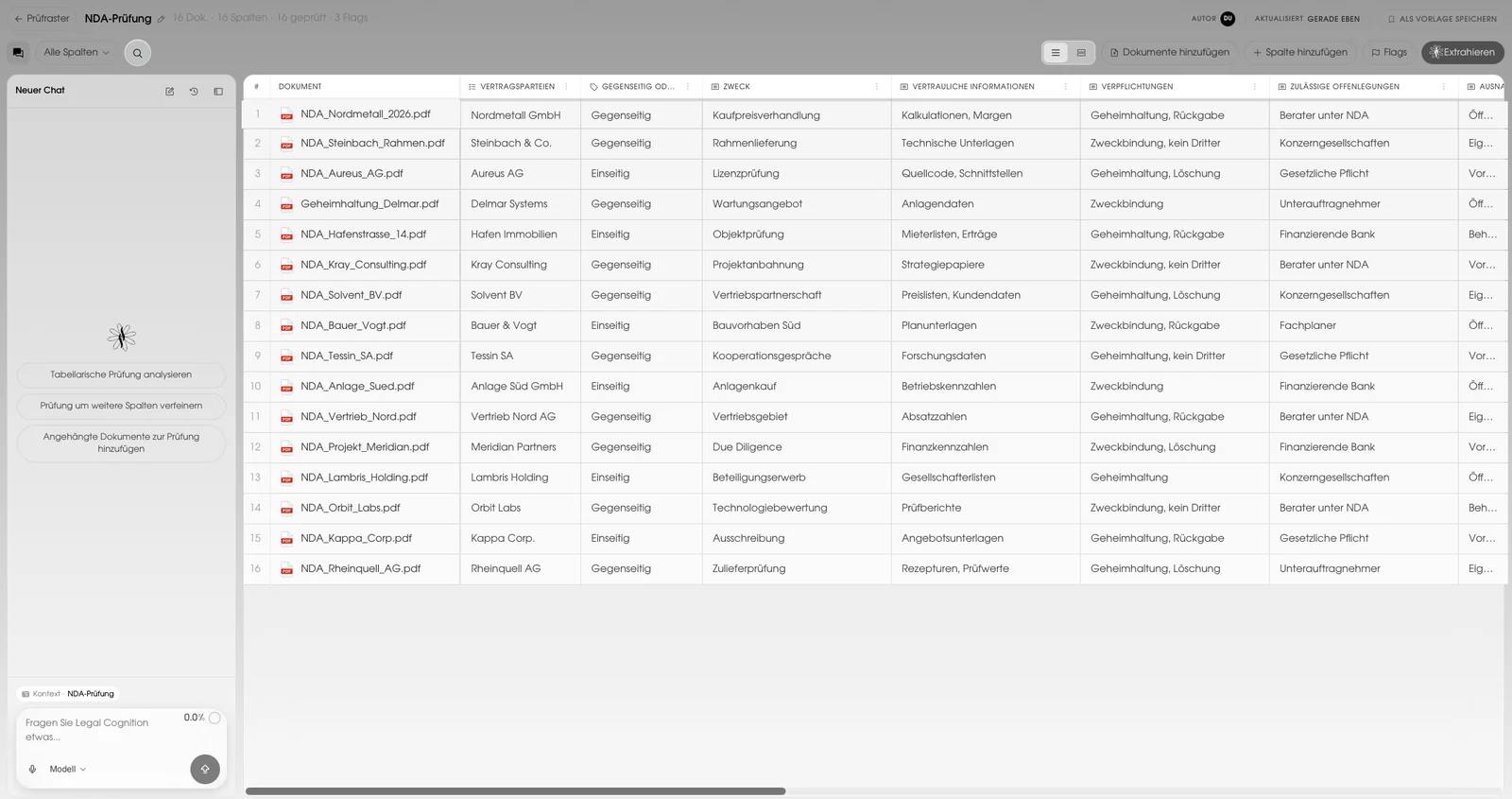
Tabular Review examines multiple documents in parallel using a shared set of questions. Results appear in a table, with one row per document and one column per question.
Choose which information and provisions to examine, such as liability caps, consent requirements or termination rights.
Findings include a verbatim quotation and source reference. You can read the passage on which each answer is based.
Ask follow-up questions about the results, such as which contracts require consent before an acquisition. The AI uses the review data to answer.
Narrow the table to the results relevant to your review. Export the findings for further work.
05 / Playbooks

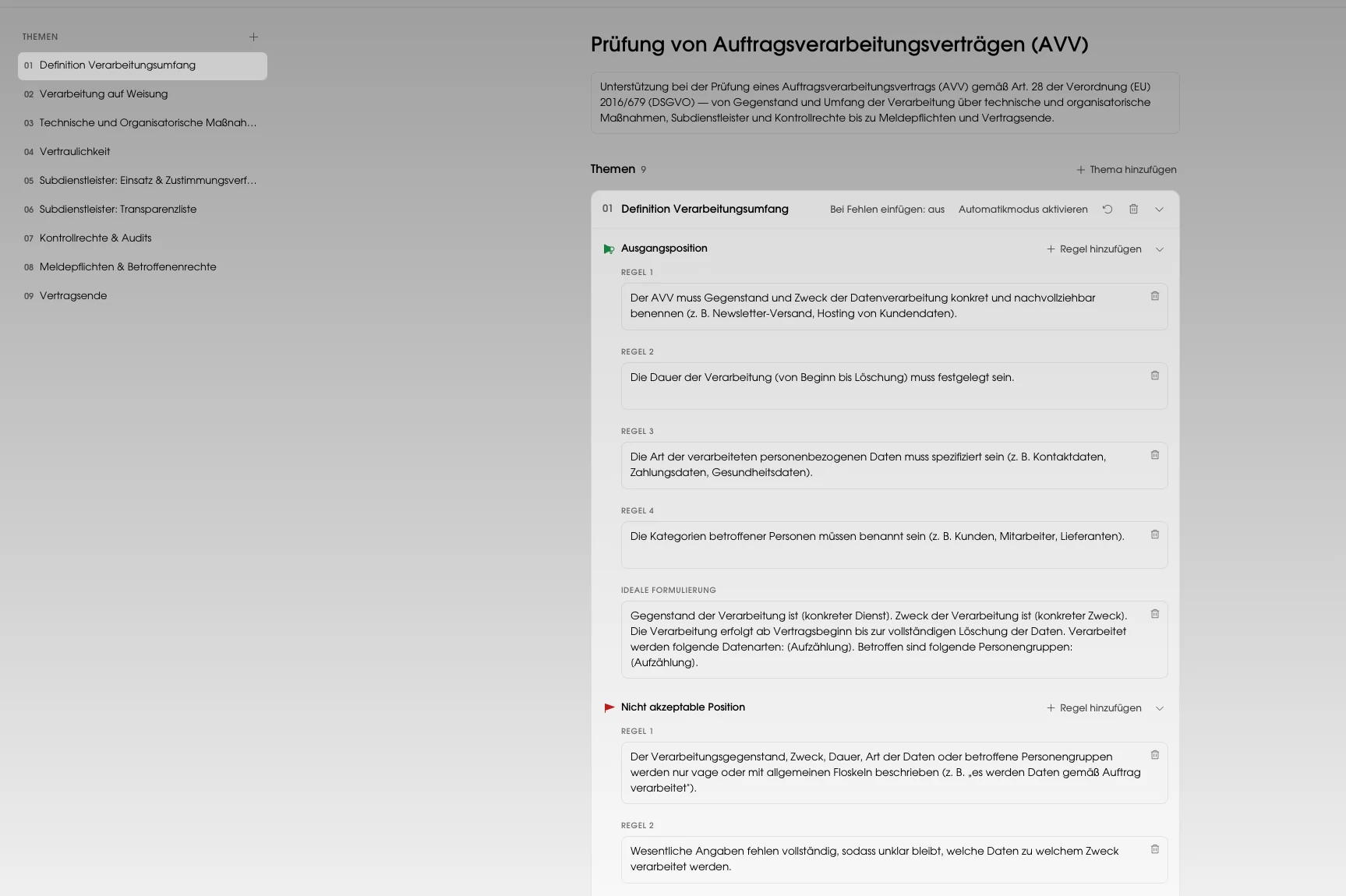
Playbooks record your organisation’s requirements for contract review. Legal Cognition checks contract clauses against them and identifies points that need negotiation.
For each topic, specify your preferred terms, acceptable departures and unacceptable conditions. Add model wording, for example for liability caps or termination rights.
The review assesses contract provisions against the positions in your playbook. You can see which clauses meet your requirements and which depart from them.
Each assessment includes an explanation and a reference to the relevant contract passage. You can check why a provision was classified as acceptable or as a departure.
Apply the same review requirements to further contracts. Upload individual documents or review documents within an existing matter.
06 / Contract intelligence

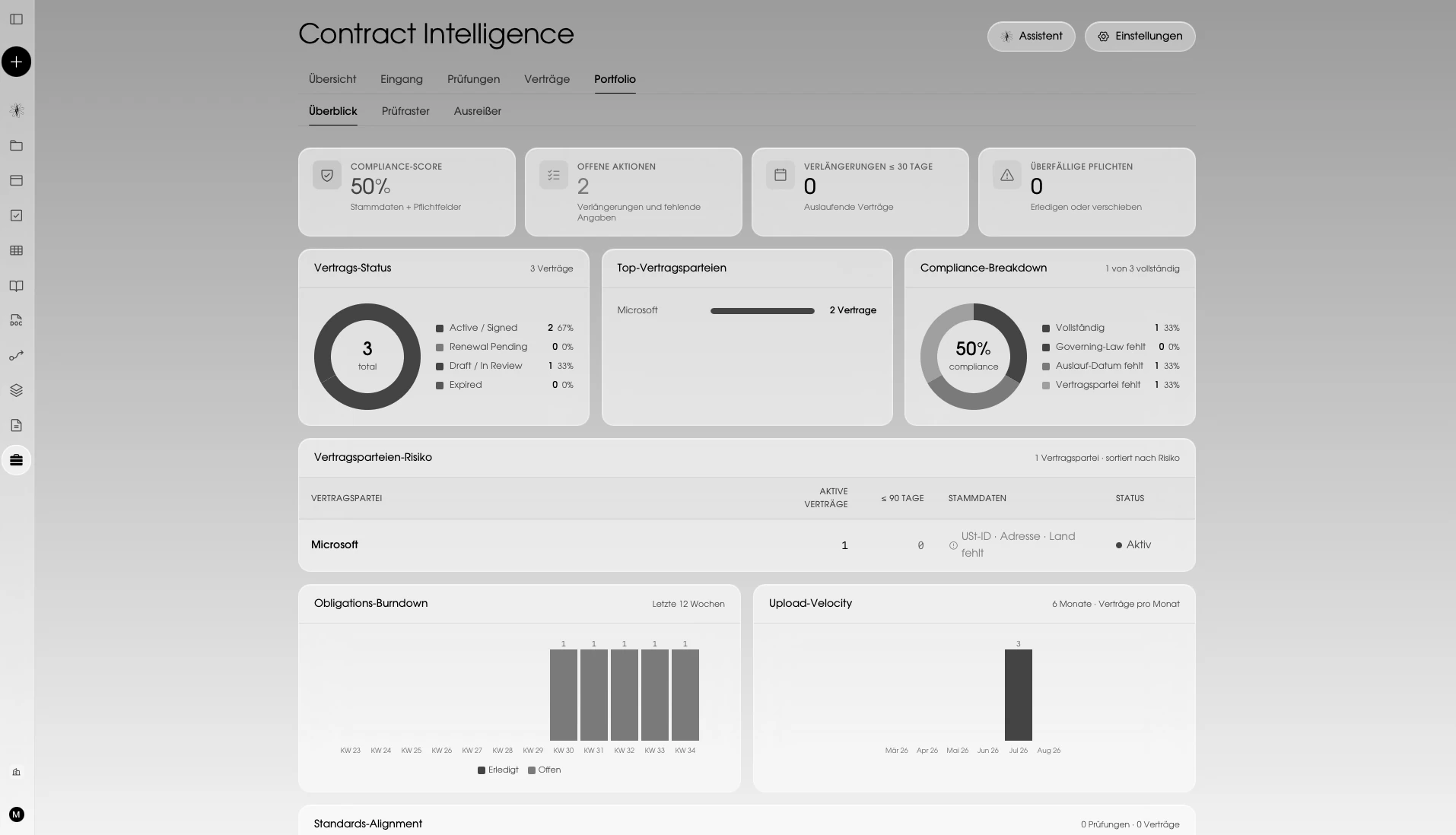
Contract Intelligence brings together contract data and review findings across your portfolio. You can see which agreements are in place, where provisions depart from your standards and which reviews remain open.
Legal Cognition extracts parties, terms, contract values, governing law and deadlines from the documents and records them in the contract register.
The overview shows which contracts contain clauses that depart from your requirements. Compare, for example, how often liability or confidentiality provisions meet your standards.
Contract values, upcoming renewals and notice deadlines appear in one overview. You can identify which contracts need attention next.
Filter the portfolio by party, clause, risk or date. Find agreements with a particular counterparty or an approaching notice deadline.
07 / Editor

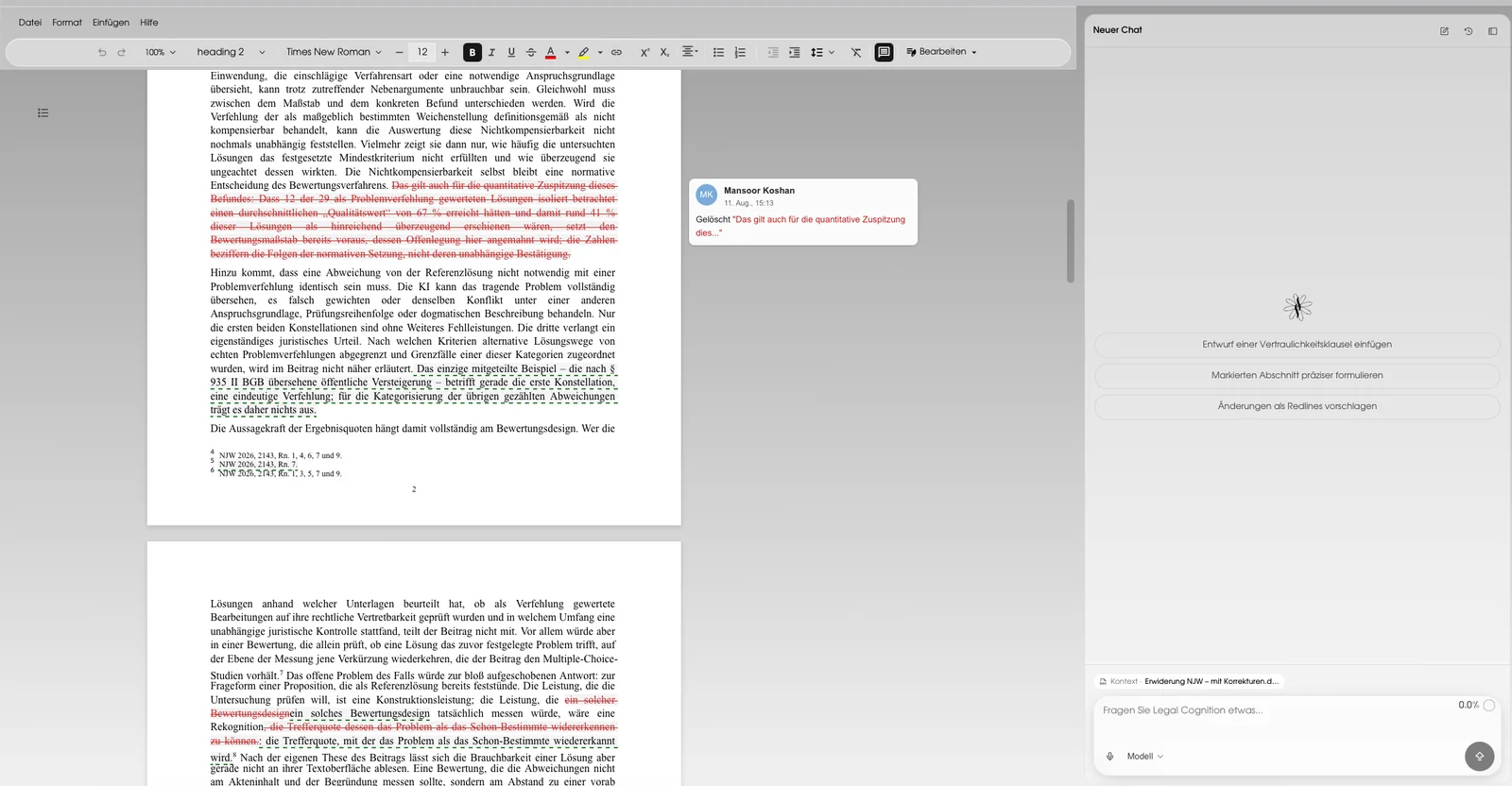
Create and edit contracts, pleadings and other legal documents directly in Legal Cognition. AI assists with drafting based on the matter documents and your professional requirements.
Ask AI to add clauses or revise selected sections. You specify the substantive changes the draft should incorporate.
Insertions and deletions appear as tracked changes. You can accept, reject or adjust each proposal yourself.
Comments and explanations appear beside the relevant passage. Questions and notes remain attached to the text they concern.
Open and edit DOCX files in your browser. Then export the document in DOCX format to continue working in Word.
08 / Dynamic templates

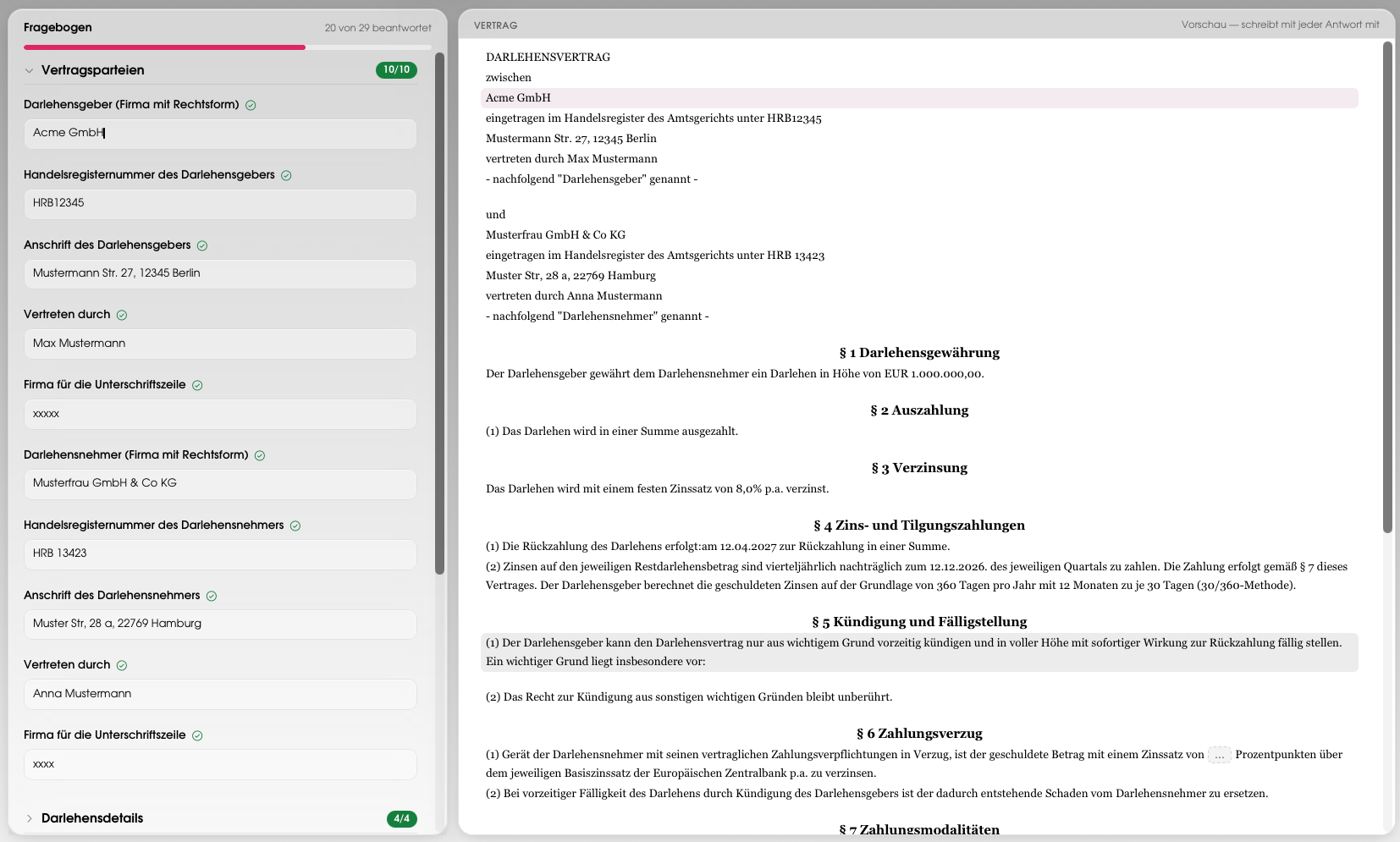
Turn your contract precedents and other standard documents into automated templates. You define which information to collect and which clauses or wording variants follow from it. AI assistants help you build the template.
Set the conditions under which particular provisions are included in the document. Templates can accommodate multiple interdependent decisions.
Link questions to the relevant information and wording variants. Answers determine both the follow-up questions and the content of the draft.
Share templates through a link or embed the questionnaire in your website or other applications. You decide whether recipients only submit information or also receive the generated documents.
Provide the template text in two languages. Both language versions use the same information and conditions.
09 / Workflow Builder

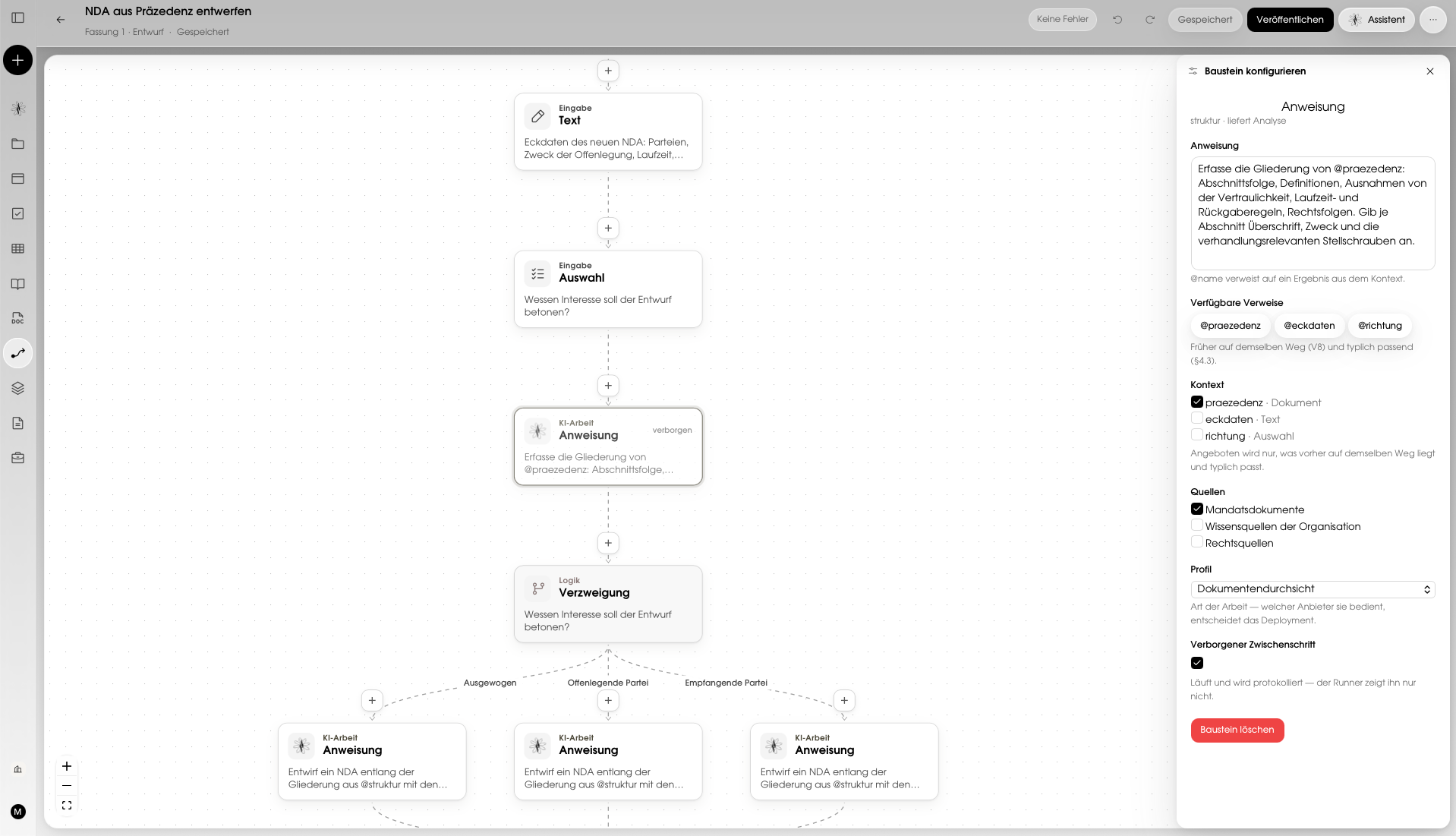
Define how recurring assignments should be handled, from collecting contract data through an AI review to drafting a document. In Workflow Builder, you set the sequence and conditions for each step.
Arrange forms, AI instructions and document templates on a visual canvas. You decide which results are passed to the next step.
Specify how the workflow responds to different inputs or review findings. Depending on the case, it proceeds to further questions, an additional review or document drafting.
For each AI step, specify the information, templates and professional instructions it should use.
Make completed workflows available to your team for further assignments. Changes are versioned so the version used can be identified.
10 / Monitors

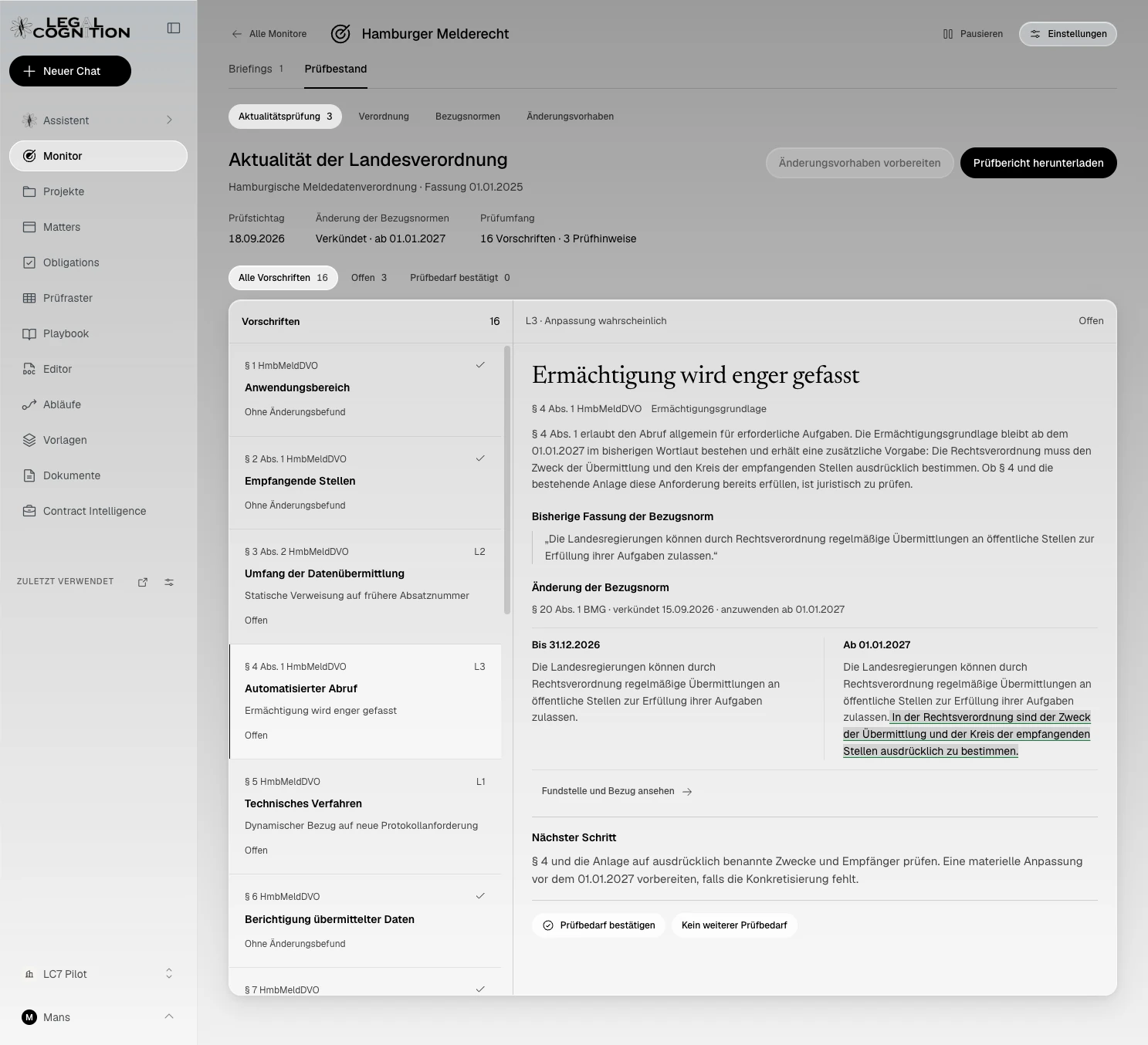
Track new legislation, court decisions and publications from public authorities and assess their impact on your work. Monitors links legal monitoring with your contract templates, playbooks and regulations. Relevant developments become concrete review assignments and, where needed, proposed amendments.
Choose areas of law, jurisdictions and available sources. New publications retain their original source and publication status. You can see when sources were last successfully checked.
Assess which clauses, contract templates, playbooks or regulations may be affected. The review links the legal source to the affected passage and explains why a review or amendment is recommended.
Prioritise relevant findings and assign review to the responsible people. Sources, documents, deadlines and progress remain together – from the first alert to the documented decision.
Turn confirmed findings into contract template redlines, revised playbook rules or draft amendments with a side-by-side comparison and reasoning. You decide which proposals are approved.
A contract draft is shaped by the facts, the legal requirements and the decisions made in negotiation. A judicial decision requires consideration of the parties’ submissions, the evidence and the legal authorities. Administrative proceedings involve examining applications and supporting documents, involving the relevant parties and giving reasons for decisions. Which information matters and which steps follow depend on the task and the participants’ roles.
Your organisation’s knowledge also informs this work. It includes established wording, experience from earlier proceedings and professional standards. Much of it is recorded in past matter files or held in individuals’ experience. This knowledge should remain available when others take over a matter or AI agents undertake assignments.
This requires more than a model. It requires infrastructure built for legal work. That infrastructure must provide access to the relevant documents and legal sources, account for responsibilities and include the tools needed to carry out the work. Legal Cognition is building this infrastructure.
Our operating system is designed to make your organisation’s legal knowledge available when an assignment is being carried out. Your professional requirements can be recorded in playbooks, templates and recurring workflows. AI agents apply these requirements to the assignment and submit their results with the sources used and the proposed changes. You should be able to see what a proposal rests on and which questions remain unresolved.
Legal judgment develops through education, experience and close consideration of each case. It is exercised within professional and institutional responsibilities. These conditions shape how we use AI. Your organisation decides which tasks agents undertake, which steps require approval and who conducts the professional review of the results.
The same applies to the technical implementation. Legal Cognition is designed to work within the systems your organisation already uses. You determine who may access which documents, where data is processed and which AI models are used.
Legal expertise should determine how AI works. That is why we are building Legal Cognition.

Security
ISO 27001 processes; certification in preparation.
Dedicated provides an isolated environment for your organisation. Distributed and Air-Gapped run on your infrastructure.
Confidentiality duties for law firms, courts and public administration.
In transit and at rest — tailored to the chosen deployment model.
Roles, responsibilities and access are logged.
Regular audits and tests keep protection current.
